When you click the link, it will take you to the corresponding page.
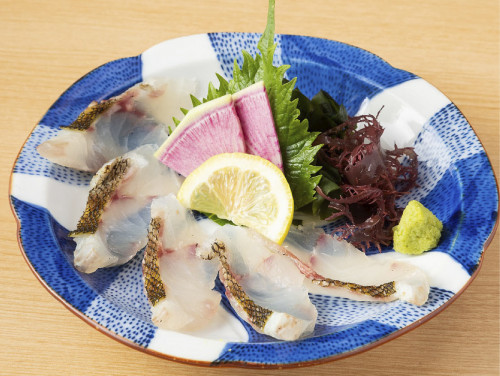
イサキの炙り刺し
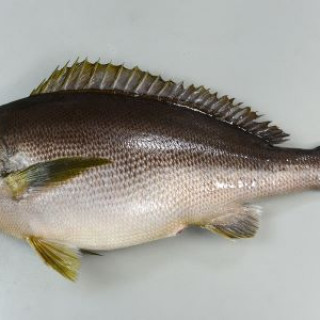
It is a warm-water fish species that inhabits waters around 20 degrees Celsius. It is primarily found in the southern seas of Jeju Island and the South China Sea. In Japan, Nagasaki Prefecture accounts for 30% of the total national catch. The fish has distinct characteristics: during its juvenile stage, which measures around 20-30 centimetres in length (referred to as '아롱이/Spotted fish/Flower child' in Jeju dialect), it has approximately three dark brown stripes on its upper body. As it matures into an adult (40-50 centimetres), these stripes become faint and nearly invisible. The fish is highly valued for its taste before spawning, with the peak season occurring in the summer months of May to July. In Japan, the period before spawning in June and July is referred to as '梅雨イサキ/Baiu Isaki' and is considered the most delicious time to consume it.
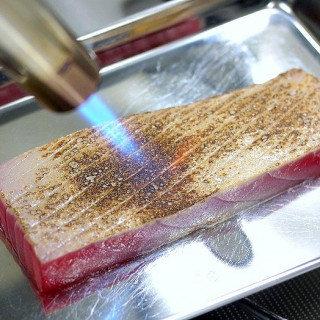
"Aburi" is a noun derived from the verb "Aburu" (炙る) in Japanese, which means to lightly sear or grill the surface of ingredients using direct flame. Unlike general grilling methods that evenly cook the entire ingredient, Aburi involves searing only the surface while leaving the inside uncooked. It is a cooking technique that allows for a contrast in texture and a smoky flavor between the outer and inner parts of the ingredients. Aburi sushi (炙り寿司), where the surface of fatty fish such as salmon or tuna is seared, is a representative example of Aburi cuisine. Even mild white-fleshed fish like sea bream can be enhanced in flavor and texture by searing the skin.